part of EQUORA Institute
HUEN
Equora Emergence Circle · 2026

The Interference Program™

Each Interference pairs two Iterators from entirely different fields. They think aloud for one evening — no moderator, no expected conclusion. What emerges between them belonged to neither beforehand, and the Resonators present carry it outward.

The Circle grows by personal invitation only. Below: the next and past Interferences, the forming program, the Iterators invited so far, and the pairings still taking shape.

Next Interference™
02
Sunday, 13 December 2026 · 16:30–19:30 · Equora Spaces, Barcsay utca 7

Star Fashion What We See, and What We See in It
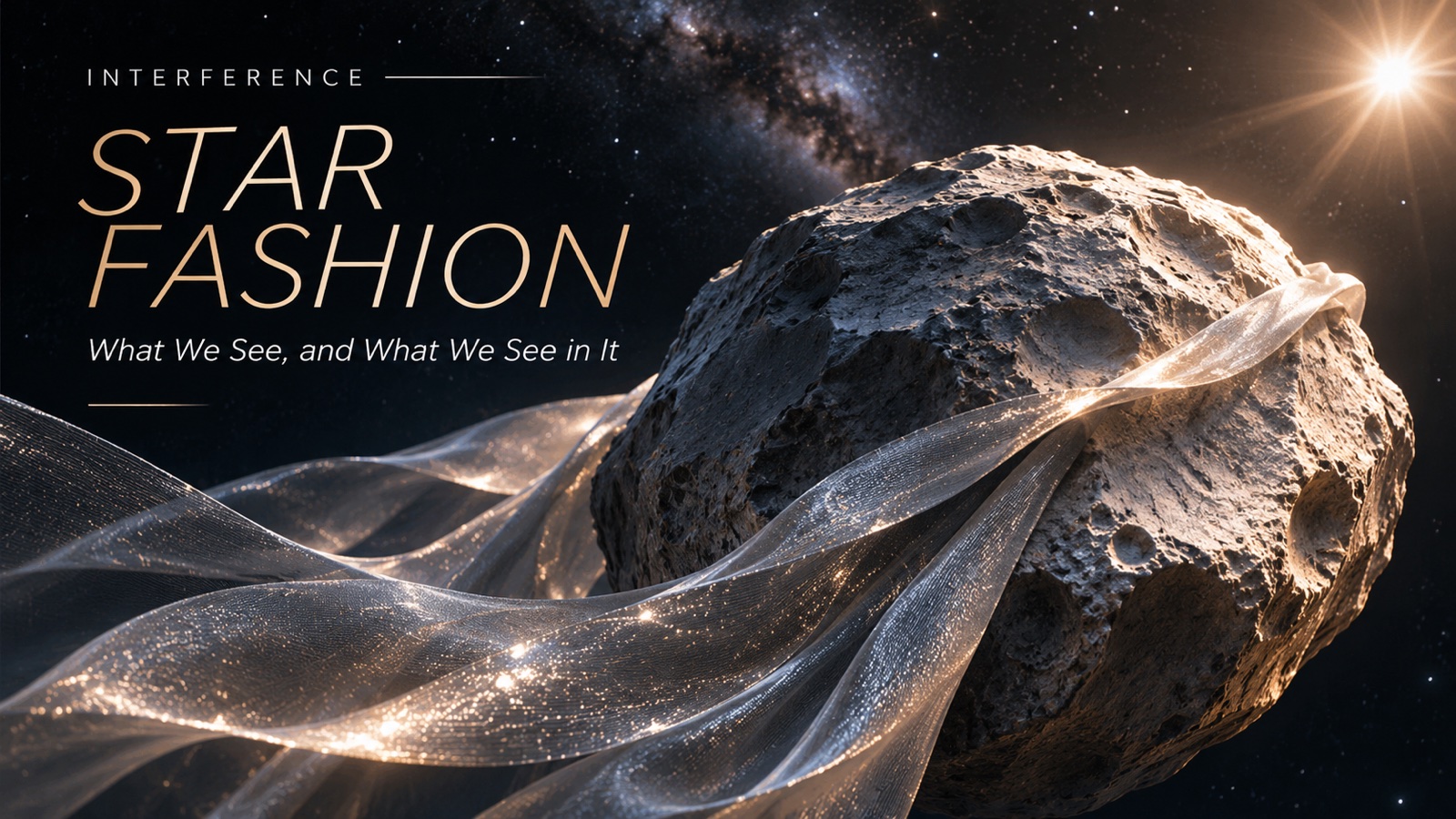
An asteroid and a glowing, translucent fabric against a starry sky — the Star Fashion Interference image
Róbert Szakáts · astronomer, Konkoly Observatory × Gábor Szakács · fashion blogger, fashion history educator, haute couture expert
What does light reveal, and how much meaning do we project onto what we see? One reads the stars, the other reads fashion; both look for the reality behind appearances, through entirely different ways of seeing.
Róbert Szakáts studies the smaller and more distant bodies of the Solar System: from their brightness, the variations in their reflected light, and their thermal radiation he infers the size, shape, rotation, and surface of asteroids. Gábor Szakács has been a regular guest at Paris Fashion Week since 2019, and reads clothing as an art form and an evolving visual language in which history, cultural identity, and social change all speak. In both worlds light carries the information, and interpretation calls for context and knowledge: an asteroid that looks brighter often simply reflects more sunlight, and a striking outfit may reveal something quite different about its wearer from what we first assume. The essential difference is that people shape their appearance deliberately: they choose their clothes, build an image, and sometimes carefully craft the impression they make. Could we know more about the physical nature of a distant asteroid than about the personality of the person sitting across from us?
Register →Free to attend; registration required.
Registration open
Past Interferences™
01
Sunday, 8 November 2026 · Equora Spaces, Barcsay utca 7

The Limits of Abstraction Different tools. Shared questions. What makes us want to learn?
Two interlocking forms of concentric lines, black and gold — the Limits of Abstraction Interference image
Rita Cserbik · abstract expressionist painter × György Lévay · prosthetics researcher
Conversation partner: Pölö — questioning, connecting the two perspectives, and bringing the room in.
One works with colour, gesture, and feeling; the other with signals, models, and experiments. Could they be learning to see the same thing?
The evening explored a proposition: at a certain level of abstraction, an artistic, emotional approach and a rational, research-driven one can arrive at the same place by very different routes. Rita Cserbik brought the experience of colour, material, and gesture — the way something takes shape before it can be explained. György Lévay brought research into prosthetic control: how human intention becomes movement through bodily signals, interpretation, and a responding machine. The painter and the researcher both have to find out what can disappear while what matters stays. Abstraction is something we learn, and learning needs something to matter to us: curiosity, fascination, frustration, or desire.
The evening's questions
  • What did they leave out, what went wrong, and how did they recognise what was worth keeping?
  • Where do their methods genuinely meet, and how far does the comparison hold?
  • What does the hand contribute to the work? Could another tool preserve the gesture, the choice, and the emotional investment while changing almost everything about the movement?
  • What kept them going when their tools gave them something other than what they wanted?

What do you care about enough to learn to see differently?

Took place

A note on the names below. The Circle is invitation-based: the Iterators here have been invited by the Curator. Some invitations are still in progress, and the pairings are shaped through conversation. A name appearing on this page marks an invitation and a direction of interest — not confirmed participation, nor an agreed pairing or date.

If you are listed here and would like your entry adjusted or removed, please write to us — it will be handled at once.

Intellectual Curator
Invitation in progress
Biochemist · network scientist · Lutheran pastor

Not the face of a show, but the guardian of the space. An integrator rather than a specialist — able to see why a fencer and a neuroscientist, a ceramicist and a photographer belong in the same room. The Curator doesn't direct; they keep the quality of the space, decide the pairings, and reflect on where the Circle is going — without stepping into the founder's role.

Invitation in progress
The pairings · 2026 season
01
Invitation in progress · prosthetics researcher × Invitation in progress · music historian
What does the body know that the mind doesn't? Both work where the learned meets the felt — in entirely different material.
The prosthetics researcher builds the control system of his own prosthesis — where a learned signal becomes a felt movement. The music historian studies how written music becomes lived sound. Both work the seam between the codified and the embodied.
Invitation in progress
02
Invitation in progress · prosthetics researcher × Invitation in progress · healthcare innovation
How does healing change when the researcher is the patient?
After losing both hands to meningitis, the prosthetics researcher develops the control system of the very prosthesis he wears — researcher and patient in one person. The healthcare innovator works on getting innovation across the gap to the clinic. The question is literally his life.
Invitation in progress
03
Invitation in progress · Olympic fencer & mental coach × Invitation in progress · neuroscientist
What happens in the brain at the moment of decision — and can it be shaped consciously? One lives it; the other measures it.
The fencer makes split-second decisions on the piste at the highest level. The neuroscientist researches exactly this: the brain mechanisms of decision, attention and learning. One inhabits the moment of choice; the other maps it.
Invitation in progress
04
Invitation in progress · professional hunter × Invitation in progress · conservation ecologist
Who is responsible for balance — and what may be killed in its name? Not a debate, but an unexpected convergence from opposite directions.
A hunter and a conservation ecologist seem to stand on opposite sides — yet both manage populations and answer to the balance of an ecosystem. The convergence, not the clash, is the point.
Invitation in progress
Pairings taking shape

Drawn from the Iterator profiles — possible Interferences the Curator is still weighing. Some names appear in more than one; the final pairing emerges from the conversations.

·
Invitation in progress · network scientist × Invitation in progress · Olympic fencer
What makes a system — a cell, an athlete, a community — resilient without making it rigid?
Invitation in progress
·
Invitation in progress · musician × Invitation in progress · music historian
What does improvisation know that composition doesn't — and what does it lose that composition keeps?
The musician's whole practice bends composition and improvisation into one another. The music historian studies how written music is made and read. The living seam of one is the research object of the other.
Invitation in progress
·
Invitation in progress · photographer × Invitation in progress · ceramicist
How does matter carry memory — and who reads it back? One in light and shadow, the other in clay.
The ceramicist treats ceramics as a medium that holds memory in its material. A photographer fixes memory in light. Two readers of how matter remembers.
Invitation in progress
·
Pölö · ISI Hypothesis × Invitation in progress · mathematician & psychologist
Where is the border between the model and reality — and who decides? The boldest pairing of the series.
The ISI Hypothesis builds a model that reaches for the structure of reality itself. The mathematician-psychologist's life work is precisely the limits of rationality and the gap between model and world. Their disagreement could be the most productive in the series.
Invitation in progress
·
Invitation in progress · abstract expressionist painter × Invitation in progress
In the act of creation, who leads — the inner instinct or the material?
Invitation in progress
·
Invitation in progress · model, dancer, aerial acrobat × Invitation in progress · prosthetics researcher
What does the body know about itself that measurement can't see — and what does measurement see that the body can't feel?
One pushes the whole body to the limit of control and expression; the other rebuilds the body's lost parts from signal and circuitry. The complete body and the reconstructed one, meeting at the edge of what a body is.
Invitation in progress
·
Invitation in progress · model, dancer, aerial acrobat × a thinker yet to be invited
When does nakedness expose, and when does it protect? Vulnerability and total control in the same body.
For the nude artist, exposure is both the greatest vulnerability and the greatest mastery. The right counterpart — from psychology, philosophy or faith — is still being sought. A question looking for its second voice.
Invitation in progress
Invited Iterators

Invited to the Circle, awaiting their pairing. Each brings a question that crosses the line their own discipline draws.

Invitation in progress
Ethologist · aging and the loss of self
Invitation in progress
Ethologist · attributing intention, dog–robot
Invitation in progress
Chef, two Michelin stars · the implicit memory of taste

Pairings shift as the program forms — a name in the roster may become tomorrow's Interference. The evenings are hosted by Equora Spaces, Barcsay utca 7, Budapest, District VII.